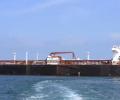
Despite ongoing tensions in West Asia, the successful arrival of the LPG carrier 'Nanda Devi' in Gujarat ensures a steady supply of liquefied petroleum gas to India, highlighting the country's efforts to secure its energy needs.

India could save $1 billion in crude oil imports annually if the country switches 10 per cent of its diesel usage in the transport sector to liquefied natural gas.

Despite Iran allowing 'non-hostile vessels' through the Strait of Hormuz, marine insurance premiums are expected to remain elevated due to persistent high-risk classifications and ongoing geopolitical tensions, with experts cautioning that the threat of attacks and collateral damage still exists.

India possesses approximately 100 million barrels of commercial crude oil stocks, capable of covering 40-45 days of its requirements if flows through the Strait of Hormuz are disrupted, according to Kpler.

The Ministry of External Affairs has confirmed that nearly 880 Indian nationals, including students, have been evacuated from Iran via Armenia and Azerbaijan due to the ongoing conflict in West Asia.

18 Indian-flagged vessels with 485 Indian seafarers still remain in the western Persian Gulf region

Two Indian ships carrying liquified petroleum gas (LPG) from the Gulf countries crossed the Strait of Hormuz early on Saturday morning, raising the number of Indian vessels safely passing through the war-hit, narrow shipping lane to three.

India's economy is projected to maintain growth above 7 per cent in 2026-27 (FY27), supported by strong domestic consumption and investment, even as global growth faces risks from geopolitical tensions, according to industry body Assocham.

The rupee plunged to a fresh low of 93.72 against the dollar on Friday, falling 1.15 per cent in a single session - its sharpest one-day decline since February 24, 2022 - as elevated crude oil prices and strong dollar demand from oil-marketing companies and foreign portfolio investors (FPIs) weighed on the currency.
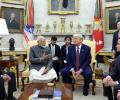
Prime Minister Narendra Modi and US President Donald Trump discussed the Middle East crisis, with a focus on the Strait of Hormuz.

Iran has not closed the Strait. It remains open; however, due to current conditions and circumstances, ships are unable to pass through the Hormuz. Otherwise, Iran never wanted the Strait to be closed or blocked, the supreme leader's representative said.

Revenue collection next financial year may be affected, and, along with this, subsidies on food and fertilisers can go up if the war in West Asia drags for long, according to experts.

Trump also called upon China, France, and Japan, among others, to send ships to the Strait of Hormuz.

India addresses the escalating conflict in West Asia, outlining its diplomatic efforts to ensure energy security, the safety of its citizens, and advocating for a peaceful resolution through dialogue.

The projected output will come from satellite fields in the eastern offshore KG-D6 block as well as North East Coast block NEC-25, off the West Bengal coast.

Amidst rising Middle East tensions, External Affairs Minister S Jaishankar highlights India's strategic dialogue with Iran to safeguard maritime traffic through the Strait of Hormuz, ensuring India's energy security and continued oil trade.

"The world might face a food crisis if the war continued till the end of April, as it could have a dramatic impact on planting in Europe and North America," said Matt Simpson, CEO of Brazil Potash.

If the conflict continues for a prolonged period, State-run oil companies may have to review retail fuel prices accordingly.

India should simultaneously prioritise domestic exploration and production of more oil and gas in the country, and ensure we retain diversified suppliers for imports, points out former foreign secretary Ranjan Mathai.

Around one full month of supply is firmly arranged with additional procurement being continuously finalised, and oil companies are successfully delivering over 5 million cylinders every day.

For weeks, the war skirted the edge of catastrophe without tipping over. Missiles flew, there was much destruction, commanders were assassinated, cities across the Gulf and even in Israel struggled to absorb the shock. But one line held: Energy infrastructure, the arteries of the global economy, remained largely untouched. That is no longer true. Prem Panicker continues his must read daily blog on the Gulf War.

Israel wishes to continue its bombing campaign until Iran's military and industrial infrastructure are degraded to a point where it ceases to pose a threat to Israel. Iran, for its part, has learnt from its experience in the 12-day war of last June. Any ceasefire, it believes, will only be a prelude to another attack on itself. It is determined to convey that any attack on Iran will impose heavy costs on Israel, the US, America's allies in the Gulf -- and on the world at large, points out T T Ram Mohan.
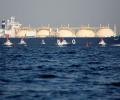
Analysts predict India will face oil price volatility and macroeconomic effects due to the escalating Iran crisis, though the country's oil supply chain is not yet structurally insecure.

The government has slashed allocation of natural gas used for LPG production, and diverted the low-priced fuel to city gas retailers like Indraprastha Gas Ltd and Adani-Total Gas Ltd to meet a part of their requirement for CNG/piped cooking gas supplies, according an official order. The government had in October and November last year cut supplies of low-priced natural gas coming from old fields such as Mumbai High and Bassein fields in the Bay of Bengal, to city gas retailers by as much as 40 per cent in view of limited output.

Indian refiners are negotiating for additional crude cargoes from the US, Russia, and West Africa to ensure adequate supplies amid Middle East tensions. Refineries are maintaining normal processing rates and deferring maintenance to build reserves. The move comes as conflict impacts tanker movements through the Strait of Hormuz, a key energy transit route.

After a three-month slowdown, India's oil imports (already landed) from Russia bounced back in the first 15 days of October to 1.8 million barrels per day.

The question is no longer whether the war will expand. It has. The next few days will tell us whether the war stabilises around Hormuz or whether the Strait itself becomes the trigger for a far larger rupture. What to watch for over the next 48 hours is simple: Any move by the US toward direct naval control of the Strait; any credible Iranian attempt to disrupt or mine shipping lanes and, critically, whether energy infrastructure in the Gulf continues to be targeted.If those lines are crossed in tandem, the war will no longer be containable within the region.

Alliances fight wars effectively only when they share an endgame. If Israel acted without US knowledge, then the military alliance is operating without real coordination at the level of strategic targeting. Neither picture is reassuring in a war that is no longer regional in its consequences. Prem Panicker continues his must read daily blog on the Gulf War.

Delhi should keep all its options open in what is essentially a transitional period in the geopolitics of energy rather than remain a gatekeeper serving Trump's 'America First', suggests Ambasssador M K Bhadrakumar.

Will rising tensions between US-Israel and Iran threaten crude oil supply through the Strait of Hormuz, putting India's fuel prices, imports, and economic stability at risk?

'The next two to three weeks will not be decided in Washington.' 'They will be decided in Tehran, in whatever calculation Iran makes about the costs of continued resistance against the costs of appearing to have yielded.'

China's Ministry of Commerce announced Tuesday it will impose counter tariffs on multiple American products, including a 15 per cent tariff on coal and liquefied natural gas, and a 10 per cent tariff on crude oil, agricultural machinery, and large-displacement vehicles.

Under the defence partnership, India and the UAE are eyeing defence industrial collaboration and cooperation in advanced technologies, cyberspace training, special operations, interoperability of their militaries and counter terrorism.

Blue Energy Motors, a Mumbai-based outfit, is set to disrupt the market for two million heavy-duty trucks running on diesel and petrol in the case of routes under 500 km by transforming them into electric.

India's decision to import LPG from the US helps it to diversify sources as it reduces almost full reliance on West Asian countries for supply of the country's primary cooking fuel.

When everyone has footage and no one can verify it, the loudest voice wins, notes Prem Panicker who begins a daily blog on the War in the Middle East.
Saudi Arabia's steep cut in LPG benchmark prices has pushed India's household LPG underrecoveries to their lowest level in over two years, slashing oil companies' losses from Rs 200-250 per cylinder last year to about Rs 20-40 now.
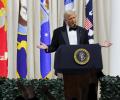
'The US is strongly placed to expand its crude supplies to India.'

Indian OMCs have not been buying Iranian or Venezuelan crude which is actually sanctioned by US. OMCs have always complied with the price cap of $60 for Russian oil recommended by the US.
Chinese import tariffs have unwittingly come to India's assistance to help boost imports of US liquefied petroleum gas (LPG) at rates cheaper than what it pays for supplies from West Asia, according to industry sources and shipping data.
 © 2026 Rediff.com - Advertise with us - Disclaimer - Privacy Policy - Sitemap - Feedback - About us - Terms of use - Grievances